
TL;DR: Can technology correct the physical biases that history left on an ancient art? Forever Snowland, an international project selected among the top 50 in the Logitech DevStudio Challenge, uses virtual reality (VR) and specialized hardware to preserve Tibetan calligraphy while simultaneously opening its learning to many more people. By removing the physical friction of the canvas, the platform finally includes the left-handed community-historically excluded from this practice-and integrates artificial intelligence with culturally validated narratives and 3D avatars.
1. Technology with a Cultural Purpose
Forever Snowland is a virtual reality project dedicated to preserving, studying, and teaching calligraphy and its traditional writing systems. It lives at the intersection of three worlds: human-computer interaction (HCI), immersive technologies, and the safeguarding of intangible heritage.
It is not an experience just for watching. It is a high-fidelity learning environment where the user executes complex calligraphic strokes on a three-dimensional canvas. The goal is concrete: to curb the risk of certain historical languages and scripts disappearing. To achieve this, the project converts a centuries-old analog practice into an intuitive digital workflow.
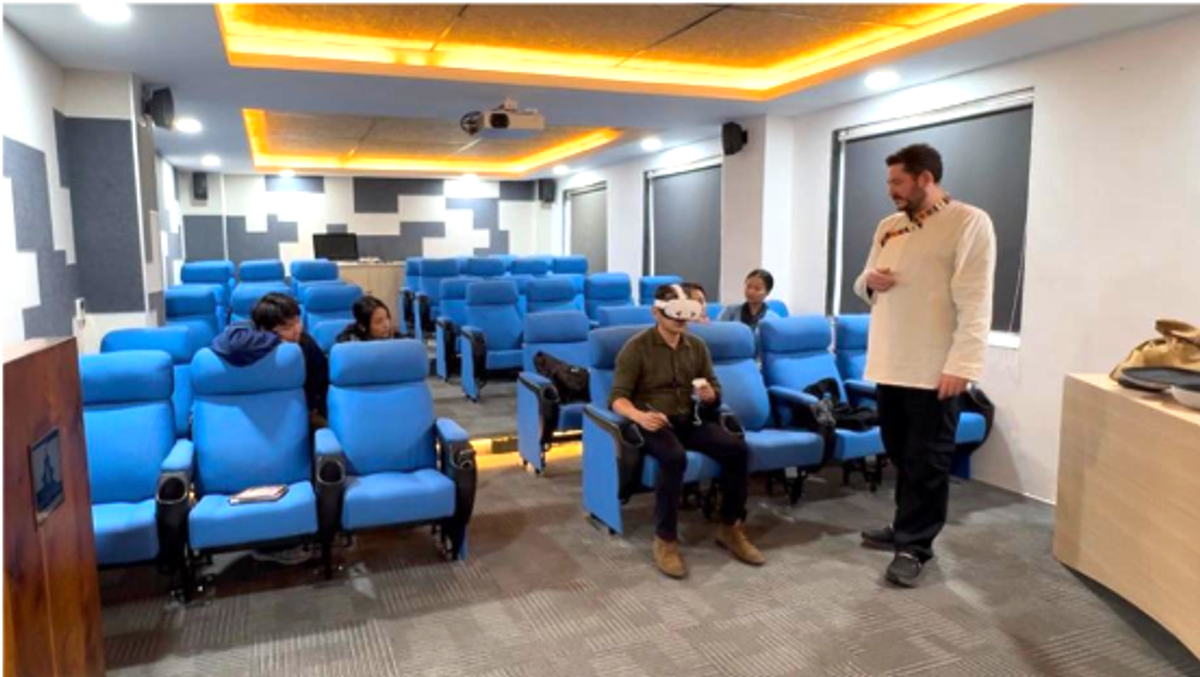
Esteban Kong, project director, at The Tibet Museum. Dharamsala, India, March 2026.
2. Field-Tested: The Logitech MX Ink and Inclusive Ergonomics
The team completed field pilot tests in Dharamsala, at The Tibet Museum and at Manjushri Educational Services. The metrics gathered there served to redesign the interaction based on two key advancements.
Hardware Tailored to the Stroke: Logitech MX Ink
Standard VR controllers are bulky and concentrate their weight in the palm. This makes them inefficient for the extreme fine motor skills that calligraphy demands. Therefore, the project integrated the Logitech MX Ink stylus, which features the ergonomics of a pen or brush.
This shift required fine-tuning the curve interpolation algorithms (splines). The system links the tip's pressure sensor with six-degrees-of-freedom (6DoF) telemetry, processing speed, tilt, and acceleration to teach stroke direction and order in real time.
No Physical Canvas, No Barriers for Left-Handers
On paper, calligraphy poses serious obstacles for left-handed people: hand dragging, reversed brush direction, and the smudging of fresh ink. For this reason, for centuries, they were forced to practice with their right hand.
By bringing ink into a virtual environment, these restrictions disappear. Left-handed users can execute and master strokes with their dominant hand, without any penalty.
3. International Recognition and Spatial Gameplay
Forever Snowland was selected as a finalist among the top 50 projects in the world in the Logitech DevStudio Challenge. Building on that foundation, the team is now developing a gameplay module inspired by word-formation mechanics, Scrabble-style.
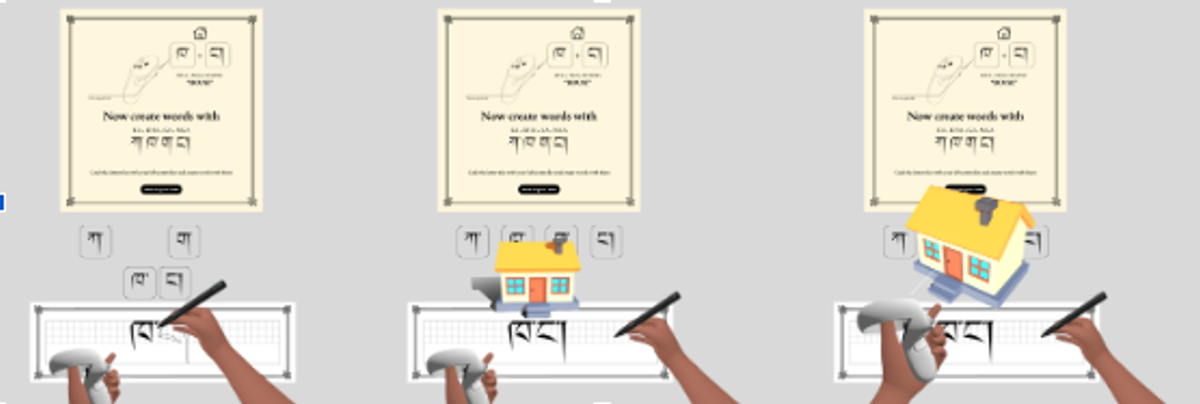
Two pieces make it work. The first is a grapheme matching engine, which evaluates sequential orientation, stroke order, and orthographic rules to validate 3D syllables. The second appeals to muscle and spatial memory: the user manipulates floating 3D typographic blocks in mid-air to solve linguistic puzzles.
4. From Specialization to Literacy: Allies Across Three Continents
The project took a strategic turn toward the literacy of young students. This involved simplifying interfaces that were previously highly specialized.
This work is supported by an international cooperation network. The Faculty of Asian and African Cultures at the University of Warsaw provides methodological testing and learning curve analysis. The forums of the Script Keepers Network connect the project with a global community dedicated to preserving writing systems. And the Callijatra Foundation verifies typographic and calligraphic authenticity.
5. What's Next: Storytelling AI and a Multi-Language Engine
Narrative Feedback and Traditional Avatars
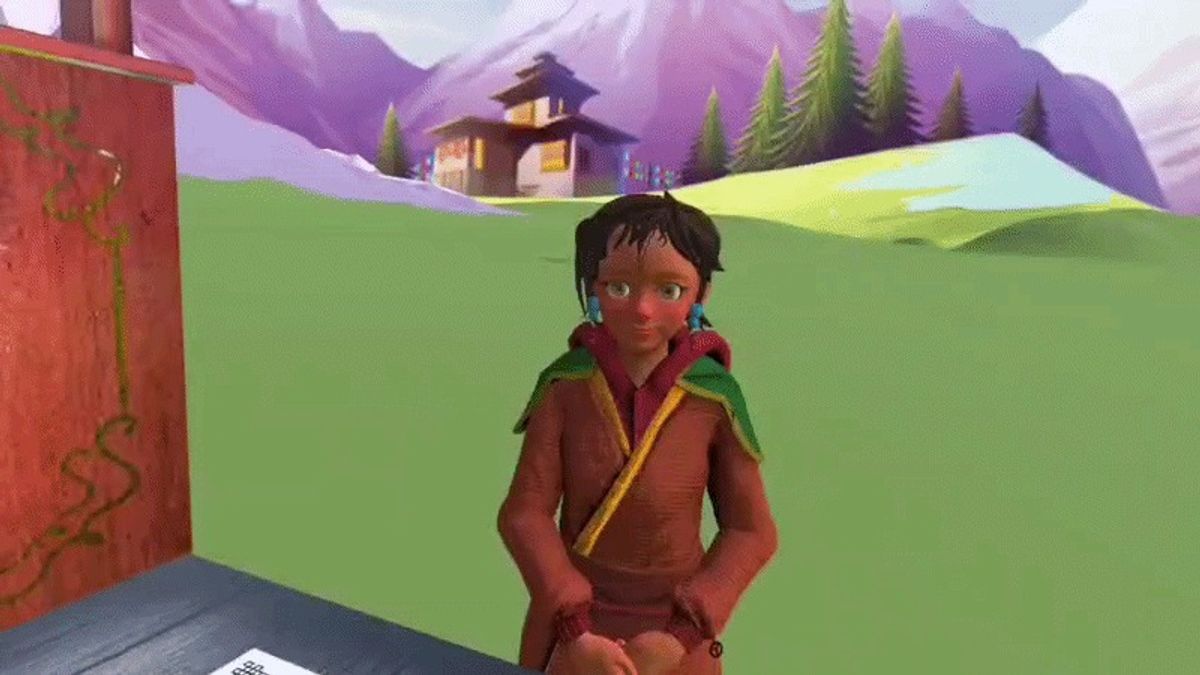
Instead of returning cold diagnostics, the system will use AI for interactive storytelling that adapts to the user. Feedback will be delivered through 3D avatars of authentic traditional characters, featuring models, clothing, and behaviors studied by the 3D animation team alongside Tibetan history advisors. This way, correcting a stroke stops being a simple onscreen error and becomes a cultural dialogue.
Jyoti, the Tibetan nomad character (Credit: Sarthak R Sthapit and Mariana Castro Yasbek)
A Calligraphic Engine for Any Script
The team is refactoring the system to decouple the rendering engine from the base language, Tibetan. The goal is to turn it into a universal, modular framework capable of loading datasets from other writing systems and endangered languages.
6. Maker Faire San José 2026: From Headset to Paper
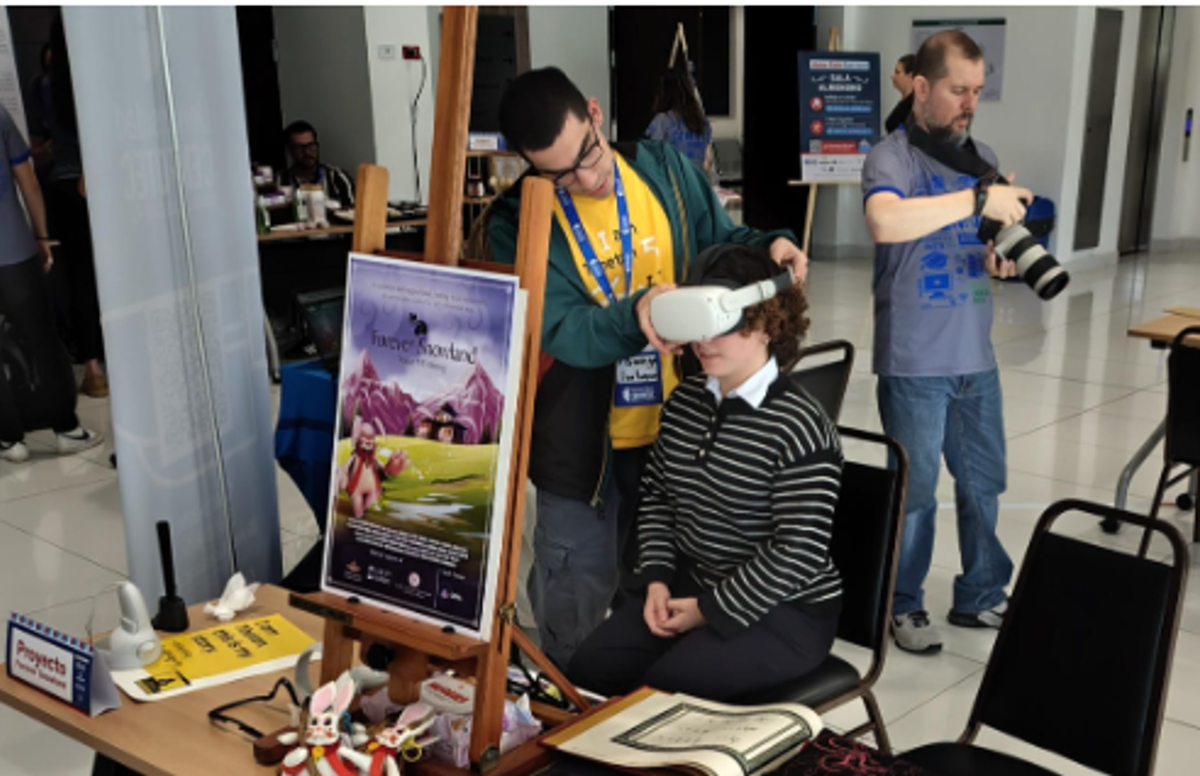
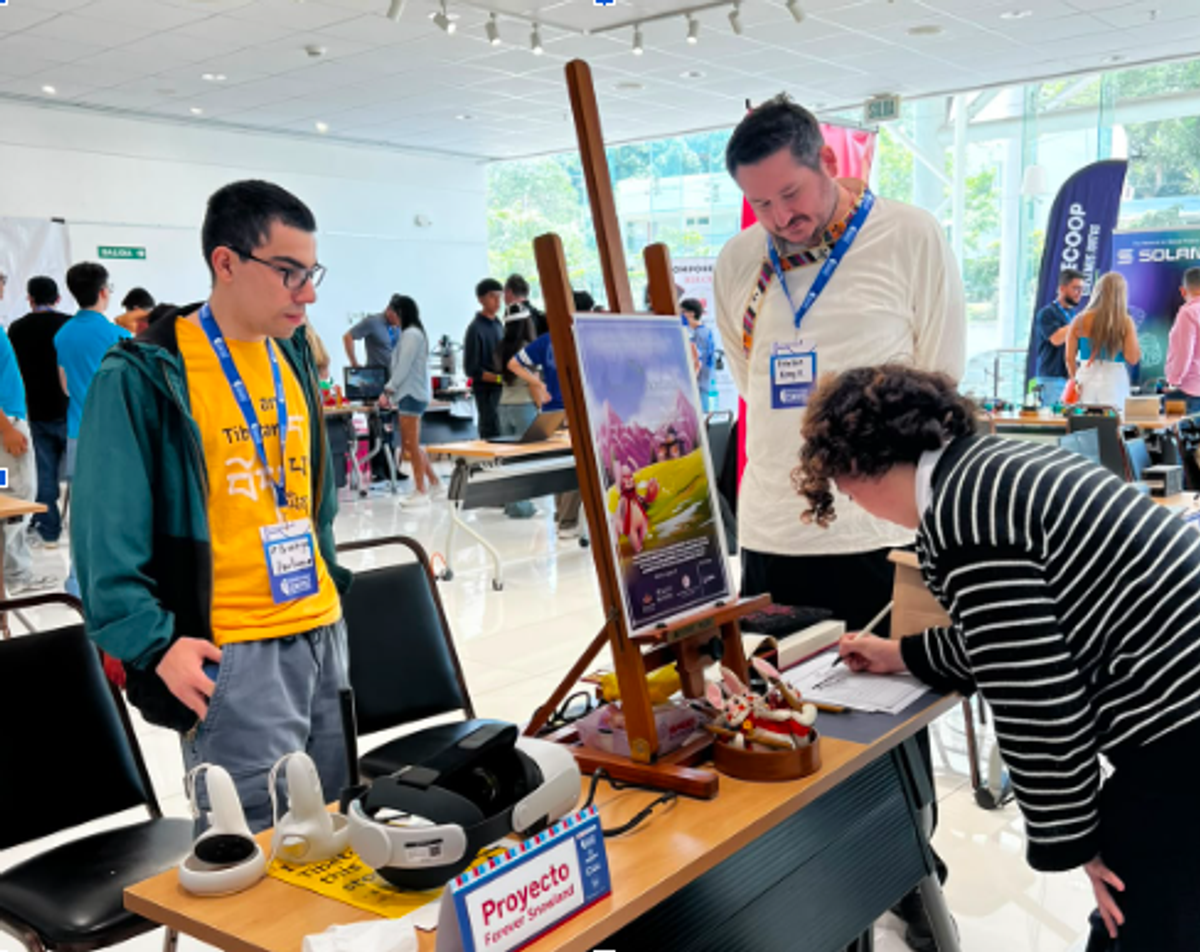
At Maker Faire San José 2026, Forever Snowland connected with more than 50 visitors. The dynamic was simple: learn for about five minutes in the application and then practice on paper.
The finding was revealing. Participants broke the barrier of perceiving the Tibetan alphabet as something foreign and gained the confidence needed to write it by hand.
Follow the Project
Forever Snowland demonstrates that preserving heritage and democratizing its learning can be the exact same task. If you want to follow what's next:
- Learn more about SpatialLab and our projects.
- Follow updates on Forever Snowland. https://tibetencostarica.org/nam-yang-bod
- For collaborations, press, or inquiries, write to us.
Forever Snowland is a project developed at SpatialLab, with the support of Cenfotec University.

